
Reliance Industries was the top gainer in the Sensex pack, soaring nearly 6 per cent, followed by M&M, HDFC twins, Kotak Bank, ITC and Bharti Airtel.

Benchmark indices faced severe drubbing on Friday, with the Sensex and Nifty falling nearly 2 per cent each amid feeble global market trends. Foreign fund outflows and fears of recession in the global economy have dented investor sentiments. Falling for the third day in a row, the 30-share BSE Sensex tanked 1,093.22 points or 1.82 per cent to settle at 58,840.79.

Among the Sensex firms, Hindustan Unilever, Reliance Industries, Infosys, Asian Paints, ITC and UltraTech Cement were the major gainers. State Bank of India, JSW Steel, Axis Bank, ICICI Bank, Tata Steel and Tata Motors were among the laggards.

Equity benchmark index Sensex buckled under selling pressure for the second straight session to close below the 65k mark on Friday, as investors offloaded IT, teck and metal stocks amid a bearish global trend. Besides, fresh foreign fund outflows also hit investor sentiments, traders said. In a volatile trade, the 30-share BSE Sensex declined 202.36 points or 0.31 per cent to settle at 64,948.66.

The last batch of quarterly earnings, global trends and trading activity of foreign investors will guide the equity market movement in a holiday-shortened week ahead, analysts said. Volatility may continue amid investors' cautious approach in the election season. Markets will remain closed on Monday due to the fifth phase of the Lok Sabha elections in Mumbai.

Ola Electric share price strategy: The meteoric rise of Ola Electric share price has left analysts and investors bewildered. Yet, they suggest investors hold on to the stock as it remains a pure "momentum" play. Since its listing on August 9, the stock has surged 92 per cent (till August 19) over its issue price of Rs 76, taking its market capitalisation to a little over Rs 63,000 crore.

The IPO market will be bustling next week, with four companies, including Bajaj Housing Finance, set to launch their initial share-sale to raise a total of Rs 8,390 crore. Besides these four main-board IPOs, nine SMEs are preparing to debut with their maiden public issues next week, targeting to collect Rs 254 crore. Together, these 13 firms are looking to raise Rs 8,644 crore through IPO.

Fundraising through qualified institutional placement (QIP) has revived this year, led by commercial banks, after a lacklustre 2022. According to data compiled by Prime Database, Indian companies have raised Rs 53,070 crore in 2023 so far, of which seven banks - Union Bank of India, Indian Bank, Bank of India, Federal Bank, IDFC First Bank, Bank of Maharashtra, and J&K Bank - account for Rs 21,290 crore, or about 40 per cent. If other financial institutions are included, the figure surges to Rs 26,690 crore.

Among the Sensex stocks, JSW Steel, Asian Paints, Maruti Suzuki India, NTPC, Adani Ports and Special Economic Zone, Bharti Airtel, ITC and Tech Mahindra were the major gainers. Reliance Industries, Tata Motors, Infosys, Mahindra and Mahindra, Bajaj Finance and Axis Bank were the laggards.

In four days, Sensex has fallen by 5,815.25 points. From the 30-share pack, 22 companies closed the day lower, led by Bajaj Finance, Maruti Suzuki India, Axis Bank, M&M, Tech Mahindra and ONGC, plunging up to 10.24 per cent.

On the Sensex chart, UltraTech Cement, HCL Tech, HDFC, Tech Mahindra, HDFC Bank and HUL emerged as the major laggards -- falling as much as 4.7 per cent. NSE Nifty dropped 63.05 points to end at 14,296.40.

The combined market capitalisation of Adani Group companies fell by Rs 54,876 crore, to Rs 10.92 trillion, as investor sentiment turned bearish on Wednesday. Shares of Adani Transmission fell by 7.7 per cent to close at Rs 886 while those of Adani Power lost 7.1 per cent to end the day at Rs 323. The stock of Adani Enterprises, the flagship company of the group, lost 6.2 per cent to finish at Rs 2,530.

Investors took the Yes Bank event negatively because it raises a question on the stability of the overall Indian financial system.

Smaller stocks have emerged as Dalal Street's favourites in 2023 that has turned out to be a "great year" for equities, rewarding investors with big gains, driven by optimism over the country's macroeconomic fundamentals and heavy retail investors participation. Experts said equity markets are experiencing a prolonged bull run and it is during this time that the midcap and smallcap segments tend to outshine their larger counterparts. Till December 22 this year, the BSE smallcap gauge has jumped 13,074.96 points or 45.20 per cent while the midcap index has surged 10,568.18 points or 41.74 per cent.

Benchmark indices Sensex and Nifty slid for a seventh straight session on Monday, logging their longest losing run in the past five months, following a bearish trend in global markets amid concerns over aggressive rate hikes by developed economies. Fresh foreign fund outflows and losses in IT, auto and oil stocks also dented investor sentiments. The BSE Sensex declined by 175.58 points or 0.30 per cent to close at 59,288.35 with 17 of its shares posting losses.

Stock market investors became poorer by Rs 8.30 lakh crore as equities continued their slide for the sixth consecutive day on Friday. The BSE Sensex has tumbled 1,855.58 points or 3 per cent since February 16. During this period, the combined market capitalisation of BSE-listed firms has tanked Rs 8,30,322.61 crore to reach Rs 2,60,00,662.99 crore. "The domestic market is broadly demonstrating a lack of confidence, registering its sixth consecutive day of losses despite global markets turning green.

'...you evaluate three key factors before committing your money.'

Investor wealth plummeted by nearly Rs 5 lakh crore in early trade on Monday as equity markets crashed tracking global equity selloff amid rising uncertainty over the economic impact of coronavirus outbreak. Market capitalisation (m-cap) of BSE-listed companies saw a massive decline after the 30-share index plunged 1515.01 points, or 4.03 per cent, to 36,061.61. The NSE Nifty too cracked 417.05 points, or 3.80 per cent, to 10,572.40.

From the Sensex pack, JSW Steel, Tata Steel, NTPC and UltraTech Cement emerged as major winners, closing the day with a gain of up to 3.33 per cent. On the other hand, Asian Paints, ITC, L&T and SBI were the laggards, ending the session up to 3.95 per cent lower. Of the 30 Sensex stocks, 14 closed the day in green, while on the 50-stock index Nifty 25 scrips ended with gains.

On the Sensex chart, M&M, NTPC, Bajaj Auto, Tech Mahindra, TCS and Maruti emerged as top gainers. NSE Nifty climbed 157.55 points to settle at 14,919.10.
The primary market will remain abuzz with more than half a dozen companies, including Hyundai Motor India, Swiggy, and NTPC Green Energy, lined up initial public offerings over the next two months to raise around Rs 60,000 crore, merchant bankers said. Apart from these three firms, Afcons Infrastructure, Waaree Energies, Niva Bupa Health Insurance, One Mobikwik Systems, and Garuda Construction are among the companies planning to launch initial public offerings (IPOs) during October-November, they added. Together, these firms are looking to raise Rs 60,000 crore through their IPOs.

Investors' wealth plummeted by more than Rs 8.47 lakh crore on Monday as the stock market continued to be ravaged by weak global sentiments triggered by mounting tensions between Russia and Ukraine. The domestic market remained in the red for the second straight session after witnessing a massive sell-off on Friday. As the counters closed for the day on Monday, the 30-share benchmark Sensex had plunged 1,747.08 points to 56,405.84 points, a decline of 3 per cent.
From the 30-share basket, 28 scrips suffered losses. Over 200 stocks were at their 52-week low in Tuesday's trade.

Hero MotoCorp (HMCL) saw strong volume performance in the first quarter of the current financial year (Q1FY25), but margins disappointed due to weak spare part sales and negative electric vehicle (EV) margins. The company hopes for a strong festive season due to better rural sentiment. Revenue grew 16 per cent year-on-year (Y-o-Y) to Rs 10,140 crore, operating profit was up 21 per cent to Rs 1,460 crore, and adjusted net profit grew 19 per cent Y-o-Y to Rs 1,120 crore.

Market benchmarks Sensex and Nifty wilted under selling pressure on Friday after a five-day rally as investors pared exposure to banking, financial and consumer durable stocks amid mixed trends in global markets. Rising global crude prices, a depreciating rupee and persistent foreign fund outflows further weighed on sentiment, traders said.

Once we break free of the idea that land is scarce, real estate is just a pile of bricks, steel, and glass. Any price surge will kick off a supply response, which kills off the possibility of sustained price appreciation, points out Ajay Shah.

A strong influx of 11 equity new fund offers (NFOs) in June, particularly within the thematic space, helped mutual funds collect Rs 14,370 crore - the highest ever via such introductory offers. This surpassed the previous high recorded in July 2021, where four NFOs accumulated Rs 13,709 crore, with ICICI Prudential MF's flexicap NFO alone mobilising Rs 9,808 crore.
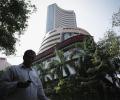
Asian Paints was the top gainer in the Sensex pack, rising 4 per cent, followed by Sun Pharma, HUL, HDFC, Dr Reddy's, Nestle India and M&M. NSE Nifty advanced 45.70 points to 14,683.50.

Investor wealth worth over Rs 13.44 lakh crore was wiped off on Thursday as the domestic equity markets tumbled along with global risk assets, after Russia launched military operations against Ukraine. Amid intensifying rout in the global financial markets, the 30-share BSE Sensex plummeted 2,702.15 points or 4.72 per cent to end at 54,529.91. The carnage on Dalal Street eroded investor wealth worth Rs 13,44,488.54 crore, taking the total market capitalisation (m-cap) to Rs 2,42,24,179.79 crore on the BSE.

'Investors should do proper analysis before putting in their money in NFOs as most new launches are in the high-risk thematic space.'

Among the Sensex constituents, 18 stocks closed in negative with UltraTech Cement, L&T, Bharti Airtel, Bajaj Finance and Tech Mahindra being major laggards. Other heavyweights like Asian Paints, Maruti, Titan and JSW Steel also saw heavy selling. In contrast, Kotak Mahindra Bank, Bajaj Finserve, HDFC Bank, ITC and SBI bucked the trend and ended the session with a gain of up to 2.09 per cent.
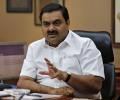
The Supreme Court on Friday said there should be a robust mechanism to ensure that the interests of Indian investors are protected in the stock market and sought views of the Centre and market regulator SEBI on PILs alleging exploitation of innocent investors and "artificial crashing" of the Adani group's stock value.

Mutual funds (MFs) invested a record Rs 1.73 trillion in equities in the financial year 2022-23 (FY23), providing strong support to the Indian markets at a time when foreign investors were redeeming their holdings. They exceeded the previous high of nearly Rs 1.72 trillion investment in equities in FY22. The data from the Securities and Exchange Board of India (Sebi) shows MFs were net buyers in the equity market in eleven of the twelve months last financial year.

Equity markets braved all odds this fiscal and rewarded investors with high returns as the benchmark Sensex surged more than 66 per cent despite COVID-led disruptions and concerns over its impact on the economy. Market analysts termed FY 2020-21 as a roller coaster ride for not only Indian markets but also for equity indices globally due to the pandemic. In an unprecedented come back, the 30-share BSE Sensex has jumped 19,540.01 points or 66.30 per cent so far this fiscal. This extraordinary rally holds significance as markets faced volatile trends this fiscal.

'For me, if I want to buy a house to stay, I don't care about indexation because I don't want to sell that house.' 'The only thing that matters to me as a buyer is that the home price should be within my reach.' 'Any market, when speculators and investors go out, it will benefit the middle class.'

According to traders, Chief Economic Adviser Subramanian's comments practically ruling out a stimulus package for the economy weighed on investor sentiment.

'Investors should continue to invest because you are looking at the long-term; in the next four to five years, we are bound to outperform (the rest of the world equity markets).'

'Like every Budget, this time, too, there is chatter around tinkering with the long-term capital gains tax.' 'Investors may not want to jump into the markets until there is clarity on this front.'

Mergers and acquisitions (M&As) by Indian companies have declined sharply by 80 per cent so far this year, in contrast with the same period last year, as bankers predict lower deal volumes due to falling profit margins of Indian companies and feeble stock markets. The decline in Adani Group shares has also hit buyer sentiment. According to data from Refinitiv, M&As in India stood at $3.3 billion from 253 deals, year-to-date (YTD) - a fall of 80 per cent year-on-year (YoY). Cross-border deals by Indian companies were also down 84 per cent to just $1.5 billion.
Worries related to the Iran-Israel conflict, quarterly earnings and foreign investors' trading activity are the key factors that would dictate stock markets this week, analysts said. Besides, trends in Brent crude oil and movement of the rupee against the dollar will also be crucial factors. This week will be crucial for the market amid ongoing worries about the conflict between Iran and Israel, said Pravesh Gour, Senior Technical Analyst, Swastika Investmart Ltd.
 © 2026 Rediff.com - Advertise with us - Disclaimer - Privacy Policy - Sitemap - Feedback - About us - Terms of use - Grievances